Showing posts with label bird. Show all posts


A late summer excerpt from my nonfiction book,  Shenandoah Watercolors, a 2012 Epic eBook finalist. Free in Amazon Kindle from August 19th through the 21st.
We’ve had many misty starts to the day this August. Haze hugs the pond, parting just enough to reveal the long-legged blue heron fishing for his breakfast. There’s a country saying about the number of foggy mornings in August being an indicator for the amount of snows we’ll have this winter––a heap, at this rate.
Dozens of swallows skim over the pond as the sun sinks below the Alleghenies. If I were standing on a distant ridge, would it sink behind me, or the ridge beyond that one?
The water is calm now but was awash with waves during the storm that hit a short time ago. The grassy hill and maple tree are reflected on the surface, silvery and streaked with rose from the western sky. All is peaceful as a soft twilight settles over the valley. Utterly idyllic, until I pause to consider what all of those swallows are after. There must be clouds of mosquitoes.
Here’s another thought, where do all the birds spend the night? Are the woods up on the hill lined with birds perched wing to wing jostling for space on the branches? I’ll bet they make room for the big red-tailed hawk. He gets the whole tree––as many as he wants. It’s good to be king.
**Image of our pond taken by my mom, Pat Churchman
**Image of Hawk by daughter Elise taken up in the meadow behind our house


An excerpt from my nonfiction book about gardening and country life, Shenandoah Watercolors, available at Amazon in kindle and also print with lovely images of the valley and mountains. (2012 EPIC eBook Finalist)
~When the world was new and I was young, I ordered a dozen Rouen ducklings (resemble large mallards) from a game farm and began my love affair with ducks, blessed by its moments of joy and cursed with inevitable tragedy.  The box of downy babies was delivered directly to my door much earlier in the day than our mail normally comes as the mailman had wearied of their incessant peeping.  
I took the new arrivals from the grateful carrier and transferred them to a corner of the family room under a warm light bulb.  My two oldest children, in grade school then, were delighted with their new playmates, but soon joined me in the discovery that these tiny creatures were incredibly messy.
The ducklings reveled in their food, spewing a mixture of feed and water on themselves, the box, and the walls.  This led to their speedy removal to an unoccupied rabbit hutch in an outbuilding.  Here they grew in sheltered bliss until we deemed them ready for life on the pond, unaware that our charges needed parental guidance.  
T'he unchaperoned youngsters soon slipped under the fence and lost themselves in the neighbor’s grassy meadow.  We tracked their frantic quacks and carried them home, only to have them forget and stray again and again.
Sadly, unwary ducklings do not know to be on guard against snapping turtles, something their mama would have taught them.  By summer’s end, just two grown ducks remained and were fondly named Daphne and Darlene.  They were inseparable and divided their day between the cows and geese in the barnyard and forays to the pond.
(*Our pond, calm on this day but often filled with ducks and geese)
The next spring Daphne and Darlene built a mutual nest inside a clump of gold-button tansy at the edge of the garden and patiently sat on the eggs that would never hatch.  It was time to find them a suitable spouse.  One fall evening “Don” arrived in my hubby’s pickup truck. (*Little creek that meanders through our meadow and under the fence to the neighbors)
The girls took an instant liking to the handsome drake, and he to them, though he showed a slight preference for Darlene.  As spring neared again, we noticed a wild mallard drake observing our little band.  He would dash forward for a bite of grain at feeding time, only to be driven away by Don.  We pitied Dwayne, as he soon became known, and tossed a handful far to the side for him.  Besides the free lunch, it seemed that Dwayne was attracted to our Daphne, much to Don’s strong disapproval.
The small male was undeterred and eventually won acceptance, amusing us by his attempts to mate with Daphne, twice his size.  Persistence won out though.  That year the girls had separate nests, Darlene at the base of a bittersweet vine, while Daphne went back to the tansy.  Don and Dwayne bonded, swapping stories as they awaited imminent fatherhood.
The ducklings hatched in late spring and grew quickly.  All survived with excellent care from their mothers.  By fall we could see Dwayne’s influence on the flock.  His offspring were considerably smaller. It was a golden, happy time. Late afternoons we quacked loudly, calling our ducks for feeding.  Heads popped up from the seeding grass and they answered back then waddled single file behind Don, their noble leader.  If we were late with dinner, they gathered to complain about the lack of service and were not averse to heading up to the house to fetch us if necessary.
Autumn in all its splendor passed into a winter that was our most severe in years.  We tromped faithfully through the deep snow every day to scatter feed on the frozen pond.  Then one morning after fresh snowfall we could not find a single duck.  Our anxious calls came back to us empty on the wind…searching revealed spatters of blood and dog tracks in the snow, the silent witness to their grim fate.   Still, we hoped that some birds had escaped the attack and combed the neighborhood, finally locating a pair of Dwayne’s offspring.  Only the smaller ducks could fly well.  We had unwittingly fed the others up to be “sitting ducks,” an expression I understand too well now.  A week later Dwayne returned on his own, but it was a bleak time.  How empty the pond seemed without the gang.
That May, Betty, our lone remaining female, hatched a fuzzy brood.  Familiar quacks again filled the air and gladdened our spirits.  It just isn’t spring without ducklings.  ~
All of this took place eons ago, but we still have ducks on our pond and an ample flock fussy barnyard geese who make daily visits down to the water.  The small town of Dayton, Virginia, not far from us, has a lovely body of water called Silver Lake (the size of a large pond) and a stream that attracts so many ducks the town has installed a duck crossing sign.
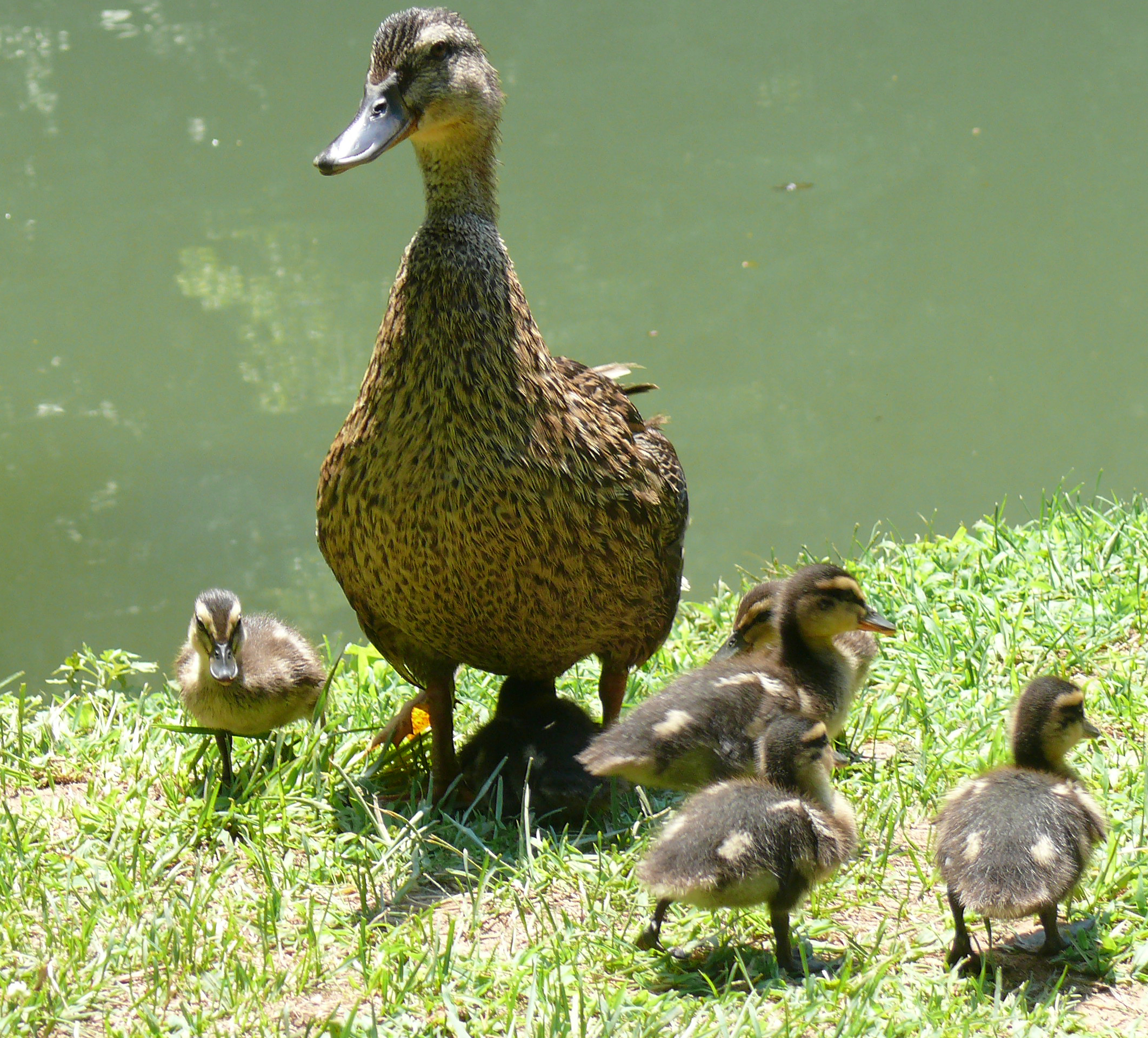
*Pics of our farm and ducks, also my mom and dad’s ducks…it’s a family thing this love of ducks. *Images by my mom, Pat Churchman.  *The one of the creek by daughter Elise.
*This story about ducklings is the one that really got me started in writing. It was ‘almost’ published in Southern Living Magazine and that editor gave me much encouragement about my writing, then she referred me to an editor at Progressive Farmer who accepted it and several more nonfiction pieces about rural life, but their free-lance column got axed before publication.
(Tame duck swimming in ‘duck weed’ in my parent’s water garden)

Against The Odds

Posted by Helen Scott Taylor | 10:38 AM | , , , , | 2 comments »

At the bottom of our garden, unfortunately don’t have fairies. What we do have is a decent sized pond boasting a small island in the center, ideal for breeding water birds.

For a few years we’ve shared the garden with a family of Moorhens that nest on the island in the spring. The Common Moorhen (Gallinula chloropus) is black with a white tail and red bill.

In mid April, my husband laid a ladder between the bank and the island, then crawled across to check out the nest. Seven smooth, glossy grayish-white eggs lay nestled in the twiggy nest among the iris stems on the edge of the island.

Incubation is between 19-22 days. We watched eagerly for the first signs of the young to hatch and venture out of the nest. Mid-May arrived with no sign of the chicks, so once again Hubby deployed the ladder and checked the island. He returned with a long face to report all seven eggs had been squashed in the nest by something, and he could see the half-developed babies dead in the mess.

We thought the adult birds might give up their breeding efforts for this year, but they built another nest and started again. We were afraid whatever attacked the nest first time around might strike again, but on June 16th Mom and Dad Moorhen appeared on the pond with seven black, fluffy chicks in tow.

Moorhens feed on water and land utilizing a mixed diet of leaves, seeds, berries, worms, snails and fish. Over the next month we enjoyed watching the chicks grow and regularly saw them on forays across the lawn in search of food. By the end of June, the chicks were bigger and stronger, but when the parents brought them out to feed, there were only three.

At this point in November, the Moorhen parents are still resident in the garden. Unfortunately, there is now only one youngster left. Sadly, the Moorhen parents laid fourteen eggs in total and raised one chick to maturity.

We can’t say for sure what happened to the young that dissapeared. Our garden is regularly visited by Badgers and Foxes, and we know there are Otters and Mink in the area. Any of these might have taken the small Moorhens.

No doubt, with the incredible persistence of all wild creatures, they will build a new nest next spring and try to raise another family—against the odds.