Showing posts with label Sounds of the Night; Toni V. Sweeney. Show all posts

It’s a well-worn scenario. Brendan Fraser and Dudley Moore did it as a comic romp in Bedazzled, Richard Burton and Elizabeth Taylor made it their romantic fling into the classics. Movies and soap operas have utilized it to the fullest in 86 film versions: A poverty-stricken young man is offered fame and wealth beyond his wildest dreams. He accepts. Now, he has everything he wants…except peace of mind. Thus begins his downward spiral into the degradation which only immense power can cause. He’s doomed. Forever. Or not. Just when everything appears lost, he wins the love of a pure woman. Will she be able to save him?

Thus is told the story of Faust, and also of Serpent’s Tooth, but Travis Brandt is no medieval scholar bargaining his soul to the devil for knowledge alone. He’s a naïve young Nebraskan, marrying early and orphaned earlier, talented and intelligent but having nothing to look forward to but a poorly-paid teaching position in an incorporated town on the Great Plains. And then his Big Break comes and he’s whisked away to Hollywood and its contingent dangers...swept into the maelstrom of sex, drugs, rock and roll…and demon worship. Too late seeing the danger, realizing the only escape is to die or disappear, he runs away and spends the next quarter century in oblivion…until he meets a former fan, Melissa Powers, a woman who loves him not for the man he was, but for the man he has become. In her he sees his salvation, but his past rears its deadly head…

In the midst of her happiness, Melissa feels Travis isn’t telling her the whole truth about why he left Hollywood, and after seeing how attentive he is to his neighbor’s son and daughter, his assertion he doesn’t want children also rings false. So what is he hiding and why is he lying?

Only too soon, she finds out.

What should have been a happy ending, with two people starting a new life together, is only the beginning, as the horror Travis left behind when he fled Hollywood is now awakened to once more reach out and threaten the former movie star and his new bride as a demon comes to claim what he’s owed.

It’s a horror story, but it’s also a love story. It’s a different type of story for me and the first written in a contemporary setting.

Serpent’s Tooth is available as ebook and in print from Class Act Books.

http://www.classactbooks.com/Serpents-Tooth-by-Toni-V-Sweeney_p_154.html


Recently, I won a free copy of Anna Kathryn Lanier's novella Salvation Bride. I thoroughly enjoyed the story and wanted to share it with everyone.

In the little town of Salvation, Texas, widower sheriff David Slade anxiously awaits the arrival of the stage. He's anxious because one of the passengers is a woman whom he's never met in person--his mail-order bride. Everyone in town is aware of what he's done and, to his consternation, it appears that they are all just as eager as he to see the lady, so there's a rather large welcoming committee waiting to meet the young woman. They aren't aware that David has asked Laura Ashton to marry him to get a housekeeper and a mother for his three-year-old daughter, Ginny, as well as to receive her five thousand dollar dowry because he's nearly submerged in debt, a fact of which he is ashamed.

Laura has ulterior motives for marrying David, also, and hasn't been exactly honest with him. She's willing to leave her home in the East and travel all the way to Texas to marry a stranger--yes--but what David doesn't know is that Laura has more than five thousand dollars at her disposal, and she's also a licensed physician. The reason she accepted his proposal is a little more basic. An unwanted suitor had tried to force himself upon her in hopes of making her marry him so he can gain control of her money, and running away is the only way to escape him.


So, she and David are wed, and it doesn't take long for Laura to find herself firmly settled in David's home, his daughter's heart, and--after a very short time--his own heart as well. Determined to have their marriage be in name only because they've had no time to get to know each other or court, David's promise lasts only a short while once the ring is on Laura's finger (and off again, because it's too large and she nearly loses it.)

Problems immediately rise, of course. Laura thinks David's emotional withdrawal from her is because he's still in love with his dead wife. She doesn't know he suffers from guilt because of things that happened to his wife while he was in a Northern prison camp during the War Between the States. David refuses to allow Laura to practice medicine because he fears people will think he can't provide for her. When she gives him more money to buy a nearby ranch to add to his own spread, this shames him, although he accepts it. These worries appear minimal, however, when Ebner Moody arrives from Laura's former home, claiming he's her lawful husband and he's come to take her back with him. Now, David finally admits he loves Laura and refuses to let her go, but Moody has a marriage certificate signed by both Laura and himself. David is determined to prove it a fake.

The interaction between David and Laura--both at their first meeting, their one-night "honeymoon" and their life at David's ranch--is at first awkward and shy, then emotional and filled with what neither recognizes as slowly-developing love. David thinks he's being lustful, Laura decides to accept whatever he gives her. Their feelings for each other have just begun to be revealed when Moody shows up, and it becomes the catalyst for the drama that comes afterward.

Salvation Bride is a short piece of fiction which I wish had been longer. Perhaps some day, the author will add to it and make it into a full-length novel.

(Salvation Bride is a Cactus Rose Miniature Rose, released by The Wild Rose Press.)

Merci to Toni V. for posting this article for me and to the Fuzzies for allowing me to blog about my newest histoire courte, "Working-class Vampires," another entry in the Clan Andriescu series. Vraiment, are these three the most hapless of les vampires, n'est-ce pas?

They were living peaceably enough in Transylvania (no peasant uprisings or anything at the time). While big brother Marius--head of the clan--was cutting a swathe through the female populace, younger brother Valerius was attempting to following in his footsteps (or should that be wing-flaps?) Cousin Timon, on the other hand, was still a little batling and a pest as far as the older vampires were concerned. Then, Marius's swathe cut a little too deeply. He seduced one too many a female from the Prince himself and promptly found himself exiled from his homeland. When he protested, the Prince, totally uncharitable and completely beside himself with jealousy (and if one infuriated prince is bad, two you don't even want to think about), exiled Valerius and Timon, also--out of sheer, Royal spite. So here our heroes were...cast adrift in the Big Bad World of Humankind...flitting all over Europe...until they land in New Orleans, Louisiana, home of Bourbon Street jazz, the vampire Lestat, and voodoo (not necessarily in that order).

Some of you may be familiar with Marius' story ("Sometimes Love Returns") and its bittersweet ending. A few may have read the slightly slapstick tale of Valerius' marriage which I asked Toni V. to submit under her name because I was too timide to use my own. (At that time I was just dipping mes orteils in the writing world's mer and was incertain how I would fare. Today, I am the auteur edite, so I now have courage to place my own nom on my work.) That story "Love, Vampire Style" was published as a Black Rosette by editeur The Wild Rose Press.

This time, Cousin Timon, is the culprit...uh, hero. "Working-class Vampires" involves him and his new bride.

Like Marius' love, Caity, Timon's wife is human...Laura Atwood. She is a best-selling auteur of romans de vampire. She also is unaware her new husband is a vampire. Interesting, n'est-ce pas? One night, as they share a romantic evening and glass of wine (Laura drinking her favorite Bordeaux and Timon a specially-bottled dark red from the family cellars--and we can guess what that is, can't we?), they discuss the route her next novel should take. In a weak moment, Timon makes crucial suggestions, never believing Lisa will take them. (After all, she rarely does what he tells her, anyway.) The next thing he knows, his wife is advertising her new novel which proves vampires are real and living in New Orleans, and the Louisiana Undead community is up in arms. It seems there is a law against revealing the actual existence of vampires and Laura has just broken it! The punishment for such a crime is death...and at the request of the New Orleans' vampire Lord, the Prince's executioner is on his way from Transylvania to carry out the sentence.

Timon and Laura have to think fast in order to escape death by broadsword.

"Working-class Vampires" will be available this month in the August 1 issue of Sounds of the Night magazine, released by sams dot publishing. Here's the trailer. Appreciez!


"See you at OSFEst," the e-mail from my publisher read.

OSFest? Who? What? Where? If I'm supposed to be there, I'd better find out. Googling brought up several hits: OSFest...the annual ostrich festival in Chandler, Arizona; OZZFest...about Ozzie Osbourne...OSFest 2003...featuring the Osmonds...nope, neither of those...OSFest, Omaha Science Fiction Education Society...Okay, that sounds more like it!

Throwing a change of clothing into my backpack, I hopped into the Sentra, feed the coordinates into the Navigator, and hit the road! (The road hit back with a right cross.) An hour later, I was in Omaha, parking the Sentra in a "Handicapped" space, and walking inside the Omaha Comfort Inn to register...and immediately searching for an ATM as I was told registration was in CASH! Cash was acquired, Registration was accomplished, and--armed with name tag and program--I was set loose in the wonderful world of OSFest. Omaha Science Fiction and Fantasy Festival, here I come!


Wandering into the Dealer's Room, I saw a half dozen R2D2s (their correct name was R2ET, I believe) in a row, waiting for Luke Skywalker to activate them and take them home. Luke wasn't available but Darth Maul, resplendent in red and black body paint, his horns freshly polished, was wandering around (looking for a Jedi to fight, no doubt) as well as several Jedi knights who were studiously ignoring him. Followed by an activated R2, I blundered into the elevator, and found myself in the Com Suite, helping myself to the buffet. As I munched on a handful of toasted, buttered, salted pecans (absolutely no calories!) I
chatted with Link from the Legend of Zelda about writing, took his picture, and asked his permission to use it in my blog. He, as well as everyone else, was very agreeable. Outside, in front of the elevators, near the sign with the convention logo, a giant snow tiger cavorted. He informed me he was "Snap E. Tiger" as he posed by the sign, then hurried away to moderate a panel, a mountain lion, and another cat of some kind weaving their way through the crowd behind him. Several men in kilts and long braids wandered by.
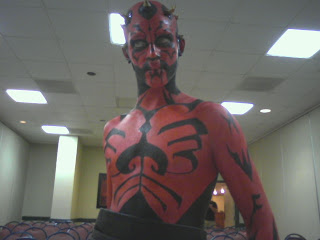

Downstairs, the lobby was congested with members of a girl's volleyball team who had gathered around Darth Maul, having their picture taken with the bare-chested lightsaber-wielder, who obligingly flicked it into operating mode and twirled it expertly without amputating his limbs or anyone else's. Others--mostly youngsters--crowded around Mr. Tiger or Link to be photographed. The Jedis watched them from a distance, with amiable tolerance.


In the Main Programming Room, NASA engineer Bridget Landry gave slide lectures on the Huygens-Cassini telescope mission, noting that the two 16th-century scientists for whom the mission was named were bitter enemies and it was ironic they would be forever linked together in aerospace history. The photos of Saturn and its moons, specifically Titan and Enceladus, were amazing...until the computer decided to crash, proving once again that man's technology is fallible. During the lecture, it was noted that by
the time a spacecraft has been designed and built and launched, the technology in it is already obsolete, and one of the first problems faced with Cassini was that the doppler effect wasn't taken into account and had to be solved (from the ground) before the now-launched spacecraft could be sent on its way. Bridget herself was a treat. Dressed in red and orange camo complete with beret (a great disguise if one is hiding in a volcano, I suppose), she appeared the antithesis of the rocket scientist. "Please!" she said as she placed pamphlets, trading cards of Saturn's moons, and temporary tattoos on the edge of the stage. "Take some. Take a lot! I don't want to take these back home. They're too heavy!" A lady with a sense of humor, she is also a devotee of Renaissance Faire and changed her costume several times during her lectures, once appearing as a Renaissance lady and once as someone who seemed to have leaped from the League of Extraordinary Gentlemen, complete with pith helmet.


Another room held science fiction-fantasy art and there were some lovely astronomy-themed paintings there, as well as prints, and sketches. The Dealers Room was also where publishers hawked their wares, writers autographed their books (being authorized by Tony-Paul de Vissage to forge his signature, I signed 8 copies of the February issue of Sounds of the Night which held a copy of his story, "Sometimes Love Returns." I also pocketed his royalties from the sales. It was only fair. I was the one getting writer's cramp!) There was a jewelry vendor with the most beautiful bracelets and necklaces,
all hand-made. I had to fight with myself not to purchase a fantastic piece called "Faust's Memories of Hell," large silver dollar-sized drops of amber shot with red and connected by silver links. The price tag ($68.00) finally stopped me. T-shirts, action figures, costumes...at one table, sat Nevermore, a ghost-hunting Omaha non-profit organization which investigates paranormal activity in Nebraska. (I stayed away. Didn't need any wandering revenants following me home.) Next to them, a movie director was selling DVDs of his latest 1950's-pastische sci-fi flick. "It's showing tonight at 10:00," he told me. "I'll be there," I promised. (I didn't make it so I bought a copy of the DVD instead.) In another room, entrants in the costume judging that night were being given pointers. Writer Kevin J. Anderson, whose novel The Winds of Dune, co-authored with Brian Herbert, is a Science Fiction Book Club offering this month, sat near the entrance, behind a table covered with his novels.


Next to the Main Programming Room was a table filled with free paperbacks. I descended upon it avidly, coming away with at least six novels which I had heard of and never managed to acquire until now.

Later, my publisher, Tyree Campbell, and I went to dinner with the artist who had the table next to ours. (Tyree had participated in a reading earlier, and was set for a panel on "Worst Mistakes by Beginning Writers" the next morning. I couldn't wait for that. I wanted to see just how many of those mistakes I had
committed.) Between swilling Mexican beer and eating everything on the menu, we had a great time. Though I didn't contribute much, it was great listening to those rapier-wits zing each other. Later, I spent some time "schmoozing," i.e., getting to know the people who ran the convention, meeting other writers, and various media representatives. I'm tentatively signed up to do a reading at next year's con, and was given the dates of several more gatherings taking place this year.


Too soon, OSFest came to an end. As Tyree packed up his table, I gathered my souvenirs. Clad in an OSFest tee-shirt, a Saturn temporary tattoo on my left forearm, my arms laden with "Anita Blake" graphic novels, pamphlets, DVDs, free paperbacks, a styrofoam clamshell filled with the remains of my dinner, and a Grape NeHi, I shouldered my pack and headed for the Sentra. In an hour, I was back home and in fifteen more minutes, was viewing e-mails from Lyrical Press telling me that the attachment was the final edit for Earthman's Bride which is coming out in August, so get to it!


Back to work, back to the mundane (?), but boy! it was a great two-day escape from reality!


PHOTOS: OSFest Sign; Link (Will Pereira) from the Legend of Zelda; Darth Maul (Tamren Cardwell from Party at My Place costumers); Snap E. Tiger; Dealers Room; Darth Maul checks out R2ET; Tyree (sams dot publishing) and Moi (sitting in for Tony-Paul de Vissage.)


Though most of them are now packed away in boxes in a storage unit, I would say I have about 500 books in my private library and a good many of them are anthologies. Some people don't like anthologies; my own mother was one of them. If a book held a collection of short stories, she wouldn't touch it. I, on the other hand, find there's nothing better than a collection of stories to give you a variety of writing styles and techniques, as well as introducing you to characters who just might become some of your favorites. There have been several occasions when I've read a short story and been so intrigued or enchanted by either the story or the characters that I've gone on to find other books by that same author. Some authors and characters I've met this way and gone on to follow faithfully: Jim Butcher and his wizard/private investigator Harry Dresden; Sir Arthur Conan Doyle and his famous creation, Sherlock Holmes, Tanya Huff and Henry Fitzroy, the vampiric son of Henry VIII, or any of Agatha Christie's detecting creations such as Hercule Poirot and Miss Marple.

I've often said I love to write too much to be able to pen "short" fiction. I start out with the best intentions, and soon get carried away and before I know it, I've got a novel on my hands! Conversely, there have been a few times when an idea just wasn't long enough for an entire book and those I've managed to turn into either a short story or a novelette. "Blood will Freeze" and "The Best Dentist in Orange County" are two which come to mind. (I actually managed to write one short story--"Death comes for Miss Naomi"--which has been rejected by every editor it's been sent too because it's too short! Go figure!) Although I've had several short stories featured in magazines, both in print and online, I find being chosen for an anthology both a struggle and an honor. When I submitted "The Key", I was told its acceptable hinged on changing one word in the text. One word! Did I agree? You better believe it!

Several times, I've been notified my stories have gone on to the second round of selection, only to be told a little later they were disqualified. The times I've been accepted, it was a fast arm-pump and a shouted "Yes!"

Presently, I have stories featured in Animal Magnetism and Wolfsongs Volume I. The former is a book of animal stories put together by S.A. Parham and W. Olivia Race, and was compiled by the editors shortly after the devastation of Hurricane Katrina. The contributors get no royalties from the book; all proceeds go to helping the animals who were either abandoned or lost their owners during the storm. My story "The Cat's Letter to his Mistress" was written in memory of my own cat, Thibault (and how appropriate is that, for a cat with a French name to be featured in a book to help the animals of New Orleans?) It's a twist on the "aliens among us" theme but a pleasant one, I think.

The other book is Wolfsongs Volume I, edited by M.H. Bonham, which explores the werewolf theme. The story I submitted, "Well-Met by Moonlight" (a paraphrasing of the words spoken by Oberon to Titania in A Mid-summer's Night Dream) was originally published on amazon.com's Amazon Shorts and later in the premier issue of Sounds of the Night magazine, put out by sams dot publishing. It features one of my vampires, Damien la Croix, and is my spin on the asteroid-striking-Earth-cataclysm theme with its own surprise ending (at least, I hope it's a surprise!) Wolfsongs Volume I recently won an award from Preditors and Editors.

There are anthologies for every taste and every genre--from Westerns to Mysteries, Horror to Romance. Try an anthology, you might like it! Think of it as a sampler...a way to let you meet new writers and perhaps help you find new favorites.

(LINKS: ANIMAL MAGNETISM: http://www.amazon.com/s/qid=1246653906/ref=sr_pg_3?ie=UTF8&rs=&keywords=Toni%20V.%20Sweeney&rh=n%3A!1000%2Ci%3Astripbooks%2Ck%3AToni%20V.%20Sweeney&page=3

WOLFSONGS VOLUME I: http://www.amazon.com/Animal-Magnetism-Parham-Olivia-Race/dp/141166664X/ref=sr_1_24?ie=UTF8&s=books&qid=1246653906&sr=1-24)


FIRST, AN EXCERPT FROM Jericho Road:
"Are you hungry?"
"That's a dangerous question! I might get slapped if I tell the truth!"
"Come on!" She smiled at him and swam toward shore.
"You go ahead," he told her. "I think I'll just stand here a minute and compose myself!"
The current chose that moment to change to a chilling cold and that helped considerably.
By the time he got out of the water, everything was back to normal and she'd retrieved the picnic basket from the car and was waiting for him.
"Shall we eat out here or would you rather we went inside and sat at the table?"
"Let's go inside." He glanced at her face. "You're beginning to look just a little pink."
After changing into his clothes, he came out to find Lindsey in her little green shift and the table set with a small banquet.
"Go ahead, sit down!" As he did so, she spooned potato salad onto a paper plate already heaped with potato chips, two kinds of sandwiches, and a crisp-fried drumstick, and handed him a plastic fork and a paper napkin.
"What--no chit'lins?"
"Chit'lins?" She made a face. "Surely you jest!"
"Just what are chit'lins, anyway? This ignorant Yankee wants to know."
"No, believe me, you don't!"
"That bad, huh?"
"Worse!" She held out a styrofoam cup.
"Ice-water?" He took the cup from her as he sat down. "Southerners must be the only people in the world who keep pitchers of water in their refrigerators." He set down the cup. "Dad is always teasing Mom about that. It used to make her furious when he'd drink all the water and leave the empty pitcher in the fridge."
"We have a rule. Last one to drink fills the pitcher," Lindsey said.
"So do we," Logan took a long swallow, adding, "but no one ever follows it."
"I think maybe you're more of a Southerner than you realize, Logan Redhawk."
"With a Southern Mama, how can I help it, Lindsey Conyers?"
"Eat your dinner," she told him.
"Yes'm! Sho' 'nuff!"
Lindsey groaned and shook her head. One thing Logan hadn't inherited from his mother was her accent. His voice was totally Yankee, clipped, and precise.

Logan isn't the only one who wants to know about Southern food, and so... My blog today is about--ta-da!--some of those oft-ridiculed and most misunderstood of Southern delicacies.

Would anyone like to tell me what chit'lin's, cracklin's, and grits are? No volunteers? Is it because no one, outside of a genuine true-blue Southerner knows? They spoken of, laughed about, but hardly anyone North of the Mason-Dixon Line (and nowadays, few below it) know anything about them. So, here it is! The Awful Truth!

Let's take them in order of importance, shall we:

GRITS: Sometimes called "hominy grits" after the North American Indian words auh('u) minea (yes, really!) which was maize hulled and broken and boiled in water and first seen by the English around 1629. Grits is a coarsely ground hominy, boiled and sometimes fried, eaten as a breakfast dish or as a side dish with meats. The word comes from the Old English gryt (900 AD)

A word of warning: grits are never eaten with sugar and milk--only butter and sometimes gravy.

BRUNSWICK STEW: A gustatory delight! A stew that usually contains chicken, rabbit, or squirrel meat cooked with tomatoes, onions, early garden peas, and shoe-peg corn. It appeared around 1850 and is named after Brunswick County in Virginia. A traditional side dish to accompany barbequed pork, which is marinated in sauce rather than basted. Ahhh! (Stop drooling, Toni.)

CHITTERLINGS (CHIT'LIN'S): Something I have never eaten and never intend to! This is the smaller intestines of swine, etc., dredged in flour and deep-fried. It originated around 1200 and comes from a diminutive of Old English cieter, intestines. Wonder if it's anything like haggis?

CRACKLINGS (CRACKLIN'S): comes from a little higher up on the hog, and is the crisp residue left when fat is rendered, what we today would call pork rinds, but chewy. It derives from a 1540 obslete Dutch word kraeckelingh. Cracklin's are usually sprinkled into white cornmeal to make "cracklin' bread hoe cakes" which were originally cooked on the blade of a hoe held over an open blaze, then crumbled into buttermilk and eaten with a spoon.

So now, you know--the secrets are revealed. And, for the piece de resistance: Southern fried chicken:

It's simple: Dredge cut-up chicken pieces in flour, salt and pepper, and fry in a skillet full of liquid lard, preferably a cast-iron skillet. When crisp and cooked through, pile your plate high with grits and gravy, buttered cracklin' bread, and a couple of drumsticks, and ENJOY!

Man, that's finger-lickin' GOOD!

(Toni V. Sweeney is a true Daughter of the South, having been born in Georgia and lived there for thirty-two years of her life. She's always regretted leaving.)


One of my favorite professors in college was Dr. Wilson Snipes. A former Naval officer, he was a character as colorful as those in the Shakespeare and Chaucer classes he taught. He was also my advisor and when I was secretary to the Chairman of the English Department, one of my employers. A tall, portly man with close-cut, graying hair and big, owlish horn-rimmed glasses, he smoked a pipe, and his arrival was always presaged by the sweet smell of tobacco.

You always knew when Dr. Snipes mounted the stairs of Willingham Chapel where he taught his classes on the second floor.

As I said, he taught Shakespeare, and Chaucer, and often stated that he would pit his students against any Shakespearean or Chaucerean scholar in the world, so confident was he in their ability to learn under his tutelage. He certainly made the classes interesting, throwing in little asides about a play or have us listen to recordings of how it would sound if spoken in the English of its time or asking certain students to research a specific phrase or item which had raised a question. I was once asked to read Dante's Inferno and report how to know the difference between male and female devils. (No, I won't tell, but it's not how you would expect!) I also had to find out what the inscription was that was written over the portal to Purgatory/Hell, but that's another story.

Needless to say, I enjoyed Dr. Snipes' classes, and as an English student, I attended many of them during my four and a half years. There are fond memories of sitting in that classroom in the second story of the ancient Chapel where I would later be employed, with the floor-length windows wide open, the summer breeze wafting in, bringing with it the sound of lawnmowers and the onion-like fragrance of Star of Bethlehem blossoms being trimmed by their blades.

Dr. Snipes and I were also friends, and when he left Mercer University to take a teaching position at Virginia Military Institute, we corresponded irregularity. When my novel Bloodseek was published, I dedicated it to him and another teacher, Dr. May F. McMillan. By that time, he wasn't around to see it, unfortunately. Nevertheless, I owe him a great deal, for instilling within me such a knowledge of the literature, customs, and characters of Times Past, as in the piece below.

Everyone is, I hope, familiar with the story of Othello, the Moor of Venice...how he fell in love with and married Desdemona, and eventually killed her after being fed lies about her fidelity by Iago, a man who seemed to have no real reason for his hatred. Iago's attitude has been a puzzle and a subject of much discussion. He's sometimes been called the first documented bigot. The following poem was written in the nineties, but it answers a question that Dr. Snipes posted thirty years before: Why did Iago hate Othello so? Was it racial, or something deeper? Or was it even hate?

I think he would have appreciated my take on the answer, couched in pseudo-Shakesperean terms:

IAGO'S DEFENCE

I never tho't 'twould end that way.
God's truth, I believed he would denounce her,
leave this place in high dudgeon, and turn
to a friend who offered comfort.
All believ'd 'twas his colour I despised; none knew
my true motive--I kept it as tightly secured
as my passion.
'Twas hatred, deep and secret, aye--but only for her--
my desire for him was shielded in villainy.
His own love I mis-took; he lost it and
his life, while I must voiceless mourn, grief
eating my vitals like an angry worm.
Why could I not say those words so tightly secured
within my heart:

"Moor, I do love thee."

Most people who've ever watched a Western movie are familiar with the name Quantrill. This Confederate guerilla and his men have been the subject of many movies and as far as I know, there has never been a sympathetic portrayal of them (as a group) yet. They fought during the War Between the States under the command of William Clarke Quantrill, a former Ohio schoolteacher, who led his men on raids throughout the state of Missouri.

Although Quantrill wasn't the only Confederate guerilla in Missouri, he was undoubtedly the most infamous. His men's job was to halt Union activities in a state which had been taken over by Federal forces and they did so with a vengeance, firing on army supply patrols, disrupting the mails and eventually attacking towns on both sides of the Kansas-Missouri border. Most of their attacks were against Union sympathizers although even Confederates might get killed if they got in the way. At that time, their opposite number was the Jayhawkers, a Union group which was equally bloody and undisciplined.

Receiving the commission of Captain in the Confederate army, Quantrill rationalized the brutality and devastation his men caused by citing the Partisan Ranger Act which allowed guerilla activities within certain limits. Most of the time, however, he and his men operated outside the law of even the Confederate forces, and he was declared an outlaw by the Union. Ranging from Missouri as far as Texas, their greatest moment of lawlessness was the attack upon Lawrence, Kansas in 1863 when they massacred 200 men and boys. Though that act alone--often called "Bloody Kansas"--brought severe censure from the Confederacy, Quantrill's forces were still allowed a free hand because of their effectiveness against the Union.

Eventually--as to be expected with such a bloodthirsty group--there was dissention among Quantrill's men and he began to lose what hold he had over them. The band began to split up, forming smaller groups who independently attacked Texas and Missouri towns. After Quantrill was killed by Union troops, these groups became more and more lawless, eventually becoming nothing more than highwaymen and bank robbers out for their own interests. Among the men who rode with Quantrill were Frank and Jesse James. After the War, during the terrorist days of Reconstruction, they formed the James-Younger Gang, consisting of brothers Frank and Jesse, brothers Cole, Jim, John, and Bob Younger, Clell Miller, Arthur McCoy, Charlie Pitts, John Jarrette (Cole's brother-in-law), Bill Chadwell, and Ace Nelson. The gang ranged from West Virginia to Texas, but eventually disbanded when Jesse and Frank decided to "go straight," and ended with Jesse being shot in the back by Bob Ford, "that sniveling little coward who shot Mr. Howard and laid poor Jesse in his grave"--as the song goes.

This was the group of men after whom I patterned the guerillas Hobbs' Raiders in my book Vengeance from Eden--lawless individuals who may have started out with the best intentions but who eventually let their baser instincts of cruelty and enjoyment of pain inflicted on the helpless take over, placing themselves outside the laws of decency in the process.

It is this band which the racist Race Jago led and it is Jago whom rancher Luke Brennan tracks from Nebraska to the little border town of Rosarita, Texas, for a final showdown with the man who destroyed his life.


At last wed to the woman he has desired for so long, Riven kan Ingan discovers that old hatreds and long ago grudges aren't absolved by wedding vows. In an attempt to protect his young wife from his enemies, he accepts a title from the Margrave, taking her away to lead the dull existence of a country noble's lady. Married life may have made Riven a love-struck fool, but he refuses to be a cuckold when he returns from battle to discover his beloved Barbara pregnant with a child he couldn't have sired. In fury at her supposed unfaithfulness, he risks the wrath of the gods and sends her to her death, only to find himself driven from his domain by a deadly curse. Haunted by Barbara's memory, Riven begins a quest to find the one who accursed him. In the years that follow, his journey will take him to the land of his birth, where he'll discover long-hidden family secrets and find himself dependent upon a barbarian woman's gentle mercy to help him rid himself of the remnants of the Blood Curse.


Blood Curse is available as an ebook and in print from Double Dragon Publications, www/double-dragon-ebooks.com/. It is the second book in the series The Chronicles of Riven the Heretic. Book One--Bloodseek--is also available.


Marius Andresciu is a vampire, born in 1752. Jaded and ancient, he's seen it all, done it all. In 1968, he wanders the streets of Paris...bored...hungry... He meets a young girl--Caity--a 22-year-old art student from New Orleans...and falls in love, something that isn't supposed to happen to his kind. He poses for her. She creates a masterpiece which will bring her fame and fortune. He leaves her because he cares too much. Her image is carved into his heart. He'll never forget her.

In 2009, Marius is living in New Orleans. He owns La Galerie, a studio known for its exhibitions of artwork by famous and soon-to-be famous artisans. He discovers Caity's masterpiece in a New York shop, buys it, plans to display it in La Galerie. Cousin Timon and brother Val argue--the statue looks just like him; people will ask the wrong questions. He shows the statue anyway, tells them the model was his father who supposedly had an affair with Caity when she studied in France.

The next day, an invitation comes in the mail...a letter from Caity inviting the son of the man she loved to her home. He thought her dead--humans are so frail--

Should he go? Can he bear to see what the years have done to the woman he knew forty years ago while he has remained as youthful as he appeared on the day he met--and loved--her? A better question would be: Can Caity accept the love of a man who seems half her age?


"Sometimes Love Returns" will appear in the February, 2009 (#4), issue of Sounds of the Night magazine. Another story of the Clan Andriescu--"Love, Vampire Style"--is available as a Black Rosette from The Wild Rose Press.


The mist rises:

It hangs like a tattered curtain over the meadow.
(Why must I lie here and wait for darkness...and for him?)

I view it from the grass.

The mist creeps:

It crawls over the flowers, curling and climbing above the trees.
It is cold; it is chilling; it has no feeling.
(Neither did he, my Night-Wing, who brought me to this place--with his sharp kisses and
promises of dark
Eternity.)

I shiver in the grass.

The mist disappears:

It dances into nothingness under the warming fingers of the sun, dwindles into a wisp of gray
and...is gone.
(A prisoner, I wait--for the moon and its coldness to free me so he and I may touch again.)

I lay cold in the grass.

(This poem was written during my angst-filled university days. Under the title "Epitaf," it was featured in the February (second) issue of Sounds of the Night Magazine, 2008.)